

Most visitors see Tuscany from the passenger seat of a tour bus or the window of a train, catching the hill towns in passing and missing the roads between them entirely. That is the part worth driving yourself: the winding cypress avenues, the vineyard stretches with no traffic and no timetable, the moment a town appears on a hilltop and takes ten minutes to actually reach.
A Tuscany road trip done properly is not a checklist of towns connected by highway. It is one continuous drive, and the car you choose to do it in changes how much of that you notice.
We design bespoke self-drive and guided driving tours across Italy, with Tuscany as our most requested region, and this guide draws directly on that experience: the roads worth seeking out, how many days to give yourself, which car actually suits this terrain, and what it takes to drive it at a pace that matches the scenery rather than rushing past it.
This is written for guests who want the wheel in their own hands rather than a seat on a coach: insider access to the roads locals actually drive, and enough support behind the scenes that the logistics never intrude on the experience itself.
Is it worth driving in Tuscany?
Yes. Tuscany rewards drivers more than almost any region in Italy. Its geography was practically built for it: rolling hills instead of flat plains, quiet provincial roads instead of congested arteries, and towns positioned on hilltops specifically so you can see them coming.
Public transport connects the major cities well enough. It does not connect Montalcino to Pienza on a Tuesday afternoon, and it certainly does not deliver you to a vineyard road with no timetable and no other cars in sight. Driving is what turns Tuscany from an itinerary of destinations into a journey defined by the space between them. The towns matter. The roads between them matter just as much.
How many days do you need for a Tuscany road trip?
It depends on the pace you want, but here is how we typically advise guests:
| Length | Best for | What it covers |
|---|---|---|
| 3 days | A first taste, paired with a Florence stay | Chianti, one hill town, Val d’Orcia as a single long day out |
| 5 days | The classic loop, our most-booked format | Chianti, Siena, Val d’Orcia (Montepulciano, Pienza, Montalcino), San Gimignano |
| 7 days | A slower, deeper version of the 5-day route | Adds Volterra, the Crete Senesi, and an extra night in the Val d’Orcia countryside |
| 10 days | A grand tour that extends beyond Tuscany | Adds Emilia-Romagna and Italy’s motoring heartland, or pushes north toward the Dolomites |
Five days is the sweet spot for most guests. It is enough time to actually stop, wander a market, take a wrong turn on purpose, and still not feel rushed between hotels. Guests weighing the longer version can see the full day-by-day route in our 10-day driving tour of Italy, which picks up where a Tuscany-only trip leaves off.
The best roads for a Tuscany drive
Not every road in Tuscany is worth seeking out for its own sake. These are the ones we build itineraries around.
The SP146, through the Val d’Orcia
This is the road you have seen in a hundred photographs without knowing its name: the winding cypress avenue near San Quirico d’Orcia, the golden fields around Pienza, the view down toward Montalcino. It is one of the most photographed stretches of road in Italy, and it earns every frame.
The SR222, the Chiantigiana
The old road through Chianti, connecting Florence to Siena the slow way, through Greve, Panzano and Radda. Vineyards line both sides for most of its length, with enough elevation change to make a well-sorted car genuinely enjoyable to drive.
The Crete Senesi, south of Siena
A quieter, starker landscape than Chianti. Clay hills, isolated farmhouses, almost no traffic. The roads here are less photographed but arguably more rewarding to actually drive, with long sightlines and a rhythm that suits a car with real character.
San Gimignano to Volterra
A shorter, hillier stretch through olive groves and Etruscan back-country. It connects two of Tuscany’s best-preserved medieval towns without retracing the more crowded Chianti route.
The Passo della Futa and the Mugello hills
North of Florence and less familiar to visitors, this is a set of tighter, more technical roads through chestnut forest, well known to locals who own a proper driver’s car. Close enough to Florence for a half-day detour without committing your whole itinerary to it.
Which car suits a Tuscany drive
The right car changes what a Tuscany road trip feels like, and the region’s mix of open sweeping roads and tighter hill-town approaches rewards different cars in different ways.
Ferrari Portofino
Our most requested pairing for Tuscany. Enough presence for the Val d’Orcia’s open, cinematic roads, and well suited to longer stretches if your itinerary continues beyond Tuscany.
Maserati MC20 Cielo
The sharper choice, for guests who want to feel the Chianti’s elevation changes rather than glide over them.
Aston Martin DB12 Volante
Built for a longer, more comfort-led self-drive across several regions. It carries the miles with less fatigue, without giving up the theatre entirely.
Porsche 992 Carrera 4S Targa
A quieter, more understated way to cover the same roads, and a genuinely rewarding one.
We talk through this with every guest before confirming a booking, because the right car is as much about the roads on your specific route as it is about personal taste. Browse the full fleet or tell us the roads you want to drive and we will recommend the car to match. Guests who want a more technical breakdown of which car suits which specific road, corner by corner, can find that in our Driving in Tuscany: Best Routes for Supercar Enthusiasts guide.
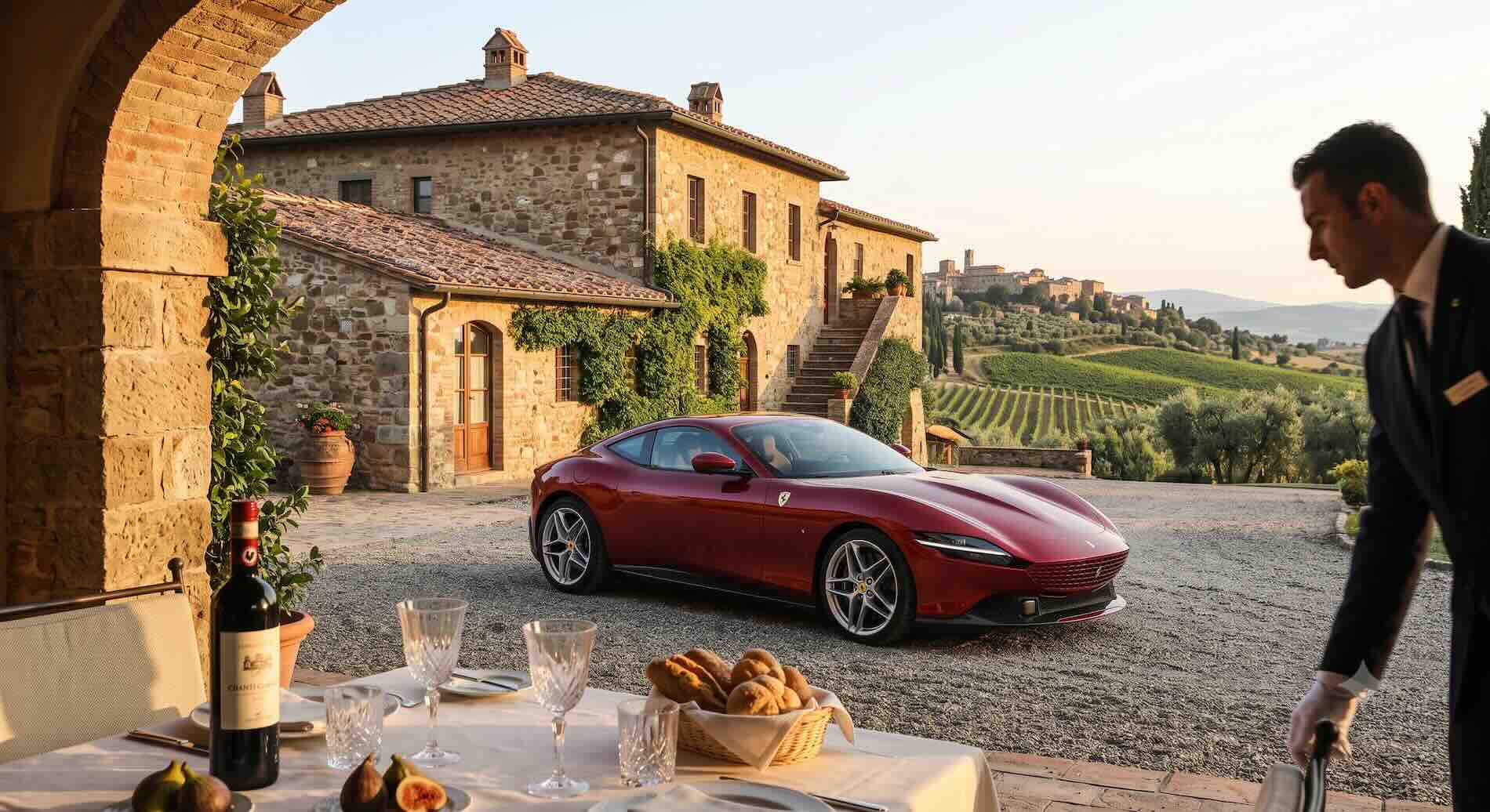
A sample 5-day self-drive itinerary
This is close to the route we build most often for guests doing a Tuscany self-drive for the first time.
Day 1: Florence to Chianti. Collect your car in Florence and head south on the SR222. Stop in Greve for lunch, continue through Panzano and Radda at a walking pace, and settle into a countryside hotel among the vineyards in time for the evening light.
Day 2: Chianti to Siena. A short, unhurried driving day, deliberately left open. Explore Siena’s Piazza del Campo on foot, wander the contrada streets without a schedule, then continue south into the Val d’Orcia by late afternoon as the hills begin to soften.
Day 3: Val d’Orcia. The heart of the trip, and the day we build the rest of the itinerary around. Montepulciano in the morning for its Vino Nobile, Pienza for lunch and its Renaissance streets, then the SP146 itself, driven slowly, with stops, until Montalcino for the evening.
Day 4: Val d’Orcia to San Gimignano. Cross the Crete Senesi on the way north. It is a deliberate detour that almost nobody driving Tuscany in a rented compact car bothers to take. Then wind through olive groves toward San Gimignano’s medieval towers by mid-afternoon.
Day 5: San Gimignano to Florence. A final loop through Volterra before returning the car in Florence, or continuing on to your next stop in Italy: Rome, the coast, or a longer route north.
We tailor every detail of this route to your dates, your pace and the car you choose to drive it in. This is simply the shape it tends to take. Prefer a shorter or longer version? The three-, seven- and ten-day variants in the table above follow the same logic, adding or removing days from either end.
Practical notes for driving in Tuscany
A few details worth knowing before you set out, whether you book with us or drive independently.
ZTL zones. Most Tuscan hill towns, including Siena, San Gimignano, Montepulciano and Volterra, have restricted traffic zones (Zona a Traffico Limitato) at their historic centres. Park just outside the walls rather than attempting to drive in. Every town has designated parking within a short walk of the centre, and we flag the right ones on every route book we prepare.
Road surfaces and width. The SP146 and SR222 are well maintained, but the smaller roads connecting hill towns can narrow considerably, particularly around blind corners on the approach to a town. This is part of what makes them enjoyable to drive properly, but it rewards a measured pace rather than a hurried one.
Fuel stops. Stations are frequent on main roads and sparser once you are deep in the Val d’Orcia or Crete Senesi backroads. We recommend refuelling in Siena, Montepulciano or Montalcino rather than waiting until the tank runs low.
Driving style and signage. Traffic keeps to the same side of the road as in the US, so the adjustment for American guests is less about which side to drive on and more about pace and etiquette. Italian drivers move with more confidence through roundabouts and tend to overtake more decisively on open country roads. Road signage follows European conventions rather than American ones, so it is worth a quick look at Italian signs before you set off. Most of our fleet is equipped with paddle shifters, so a manual gearbox is not something you need to think about.
The International Driving Permit. American guests need one alongside their US licence to drive legally in Italy. AAA issues it in a few minutes for a small fee, and we flag it early with every US guest so it is sorted well before departure, not discovered at the rental counter.
Self-drive or guided: how we do it differently
There are two ways to experience a self-guided driving tour of Tuscany with us, and neither one is the generic version you will find elsewhere. Both are tailor-made around your dates, your pace and the car you choose.
Self-guided, with full support. Collect an exceptional car in Florence, whether that is a Ferrari, Maserati, Aston Martin or Porsche, and set out on your own schedule. We prepare the route book, arrange insurance and logistics, and remain reachable throughout, but the pace and the decisions are entirely yours.
Fully guided, with a dedicated support vehicle. For guests who prefer not to think about logistics at all, our Tuscany & Umbria driving tour is a multi-day itinerary through Siena, Montepulciano and the Val d’Orcia, continuing into Umbria’s quieter countryside, with hotels, route planning and on-road support arranged from start to finish.
Either way, the car is never an afterthought. Choose between the theatre of a Ferrari, the sharper edge of a Maserati MC20 and the grand-touring comfort of an Aston Martin, each suited to a slightly different kind of Tuscan road.
What’s included. A self-drive Tuscany itinerary with us includes the car for the full journey, insurance cover, a proper handover briefing rather than a rushed key exchange, and a detailed route book built around the roads in this guide. Hotels, restaurant recommendations and additional route planning can be added if you would rather not organise those pieces yourself. The aim is an effortless handover, even when the itinerary itself is entirely in your hands.
When to drive Tuscany
The Tuscan countryside looks different depending on when you drive it, and some months suit the roads far better than others. May and June bring the Val d’Orcia’s wheat fields to their fullest green-gold, before the summer heat sets in, with comfortable temperatures for long days behind the wheel. September and October trade that for harvest season in Chianti and Montalcino, with vineyards turning amber and considerably fewer tour coaches on the roads that matter most.
July and August bring heat, glare and considerably more traffic on the Chianti and Val d’Orcia roads: not impossible, but not the version of Tuscany we would choose to show you. Winter has its own quiet appeal for guests who have driven Tuscany before and want to see it stripped back: mist over the Crete Senesi, empty roads, log fires in countryside hotels, though days are shorter and some rural properties close for the season.
Frequently asked questions
How many days do I need for a Tuscany road trip?
Five days is enough to drive the classic Chianti, Siena and Val d’Orcia loop at an unhurried pace. Three days works as an add-on to a Florence stay. Seven to ten days allows for a slower pace or an extension into Emilia-Romagna.
What is the most scenic drive in Tuscany?
The SP146 through the Val d’Orcia, particularly the stretch near San Quirico d’Orcia and Pienza, is widely considered Tuscany’s most scenic road. The SR222 Chiantigiana through Chianti is a close second.
Do I need a car to explore Tuscany properly?
Trains and buses connect the main cities, but most of what makes Tuscany distinctive, from hill towns to vineyard roads to the Val d’Orcia itself, is only accessible by car.
Can I self-drive a Ferrari or Maserati through Tuscany?
Yes. We arrange self-drive rentals with collection in Florence, Rome, Milan or Venice, complete with route guidance and support throughout your trip.
Do I need a special licence to drive a supercar in Italy?
A standard driving licence valid in Italy is all you need; there is no separate licence for a Ferrari or a Maserati. US citizens do need an International Driving Permit alongside it, which Italian law requires and AAA can issue quickly before you travel.
What’s the best time of year for a Tuscany driving tour?
May, June, September and October, when the roads are quieter and the temperatures are ideal for a full day behind the wheel.
Are ZTL zones a problem for a Tuscany self-drive?
Not if you know where they are. Most historic centres restrict driving access, but parking is always available just outside the walls, and we mark every relevant zone on the route book we prepare for self-drive guests.
Can I combine a Tuscany road trip with other regions?
Yes. Tuscany connects naturally to a longer route into Emilia-Romagna and Italy’s motoring heartland, or south toward Rome and the coast, and we can extend any Tuscany itinerary in either direction.
Plan your Tuscany drive
A good Tuscany road trip is not about seeing everything. It is about choosing the right roads, giving them enough time, and having a car underneath you that makes the driving itself worth remembering.
Tell us when you are thinking of travelling and how many days you can give it, and we will put together a route built around the roads in this guide, whether you would rather drive it yourself or have us handle the whole thing.