

A compact rental car and a Ferrari Portofino do not experience the same road. A rental car needs a road that connects two towns. A supercar needs consistent surface grip, predictable camber, long sightlines for safe overtaking, and corners that reward a stiffer chassis and a wider power band. Few Tuscan roads meet all four criteria, and it’s a question we get asked about more than almost anything else. This guide ranks the five we keep coming back to, and explains why each one earns its place.
What makes a road suited to a supercar
Four factors separate a road worth driving in a Ferrari or Maserati from a road that simply gets you somewhere.
Surface consistency. Supercars run low ground clearance and stiff suspension. A road with frequent patching, gravel edges or broken asphalt transmits every flaw directly to the driver and risks the underbody. The roads below are maintained to a standard that suits low-riding cars.
Sightlines. Overtaking a tractor or a tour coach safely requires seeing far enough ahead to commit to the move. Roads with long, open sightlines let a car with real acceleration use that acceleration. Roads with blind crests and hedgerows do not.
Corner geometry. A supercar’s chassis is tuned for corners with a defined radius and consistent camber, not the tight, decreasing-radius turns built for horse carts and rarely resurfaced since. Wider, cambered corners let the car’s balance and grip actually register.
Traffic density. Even a well-surfaced road with the right corners loses its value in a queue of rental cars during August. Timing and route choice matter as much as the road itself.
Gradient. Sustained climbs and descents change how a car behaves. A naturally aspirated engine holds its power band longer on a graded climb than in flat cruising, and a car with strong brakes benefits on the way back down. Flat roads test none of this. The routes below include a mix of flat and graded sections for exactly this reason.
None of Tuscany’s public roads offer closed-circuit conditions. There are no runoff areas, no marshals and no guarantee of an empty road. The five routes below score highest against the four criteria above, not against a race track, and they are driven within Italian traffic law at all times.
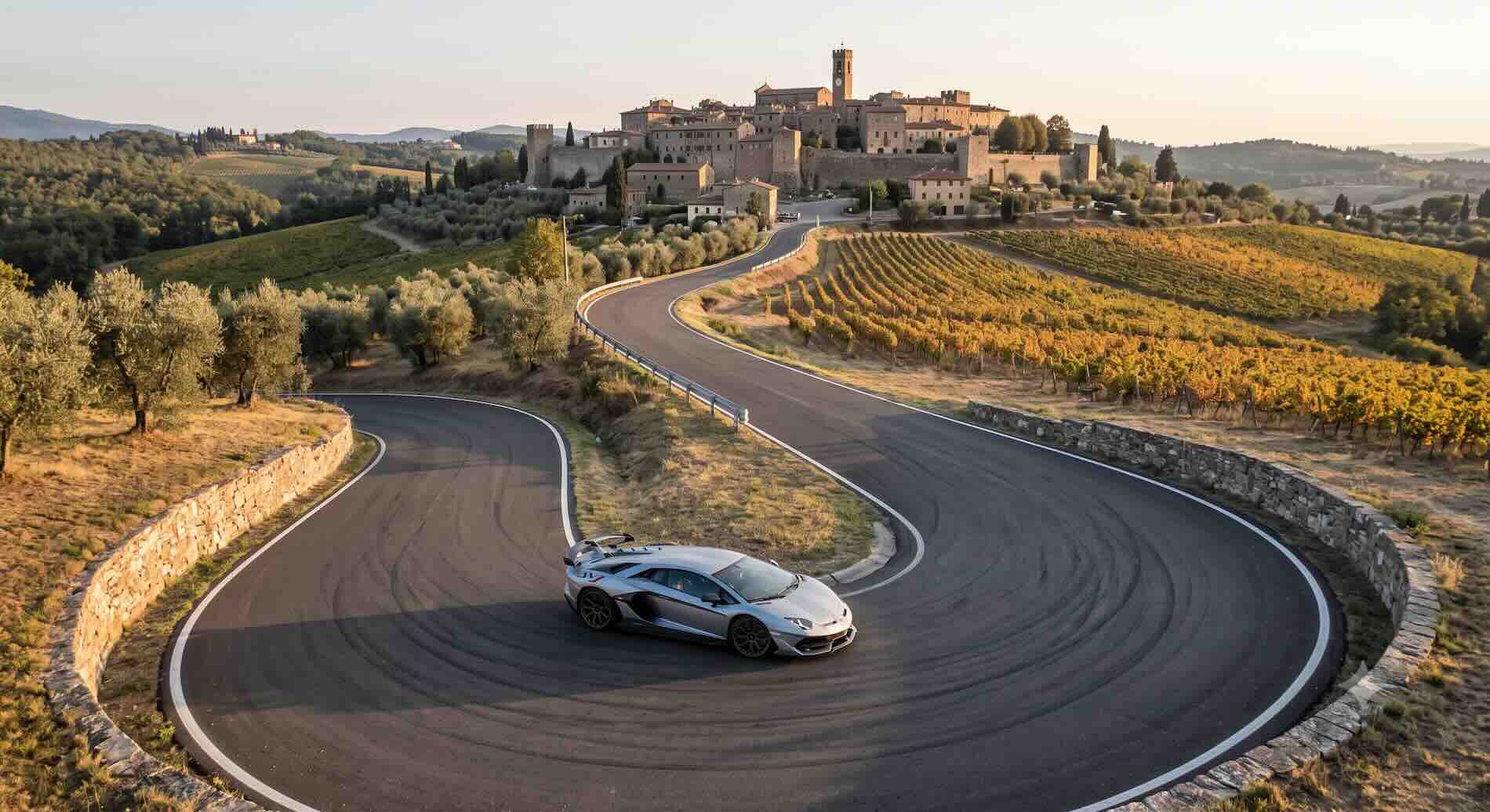
The five routes
The SP146, Val d’Orcia
Straight sightlines across open, rolling terrain, with a consistent surface and gentle elevation change over roughly 10 km between San Quirico d’Orcia and Pienza. This is the road for a grand tourer’s higher gears: long visible stretches, gradual curves, minimal traffic outside peak summer. The camber stays consistent through most corners, which matters more than corner count on this particular road. It suits a Ferrari Portofino or an Aston Martin more than a stiffer, sharper car, since its rewards come from flow rather than technical cornering.
The SR222, Chiantigiana
More elevation change than the SP146, with tighter, off-camber sections through Greve, Panzano and Radda across roughly 70 km between Florence and Siena. The corners here have real definition and reward a car built to change direction quickly. Surface quality varies more than on the SP146, with rougher patches on some of the older village approaches, so a car with adjustable damping has a real advantage here. A Maserati MC20 Cielo feels more at home on this road than on the SP146.
The Crete Senesi backroads, south of Siena
Long, open sightlines across clay hills with almost no traffic outside local farm vehicles. The roads here are narrower than the SP146 but carry far less traffic, and the surface is consistent across most of the network. Corners are wide and predictable rather than tight, which means the limiting factor is sightline, not grip. This is the route for a car with a strong top end and few opportunities to use it elsewhere in Tuscany.
The Passo della Futa, Mugello hills
Tighter, more technical mountain road through chestnut forest, with real switchbacks and a stiffer surface built for mountain traffic rather than tourist coaches. Elevation gain is significant compared with the other four routes, with a sustained climb followed by a sustained descent rather than the rolling terrain found further south. It sits a short drive from the Mugello circuit, one of Italy’s motorsport centres, and the road itself reflects that heritage: narrower, more demanding, closer to a proper mountain pass than anything in the Chianti or Val d’Orcia.
San Gimignano to Volterra, via the back roads
A shorter route through olive groves and open countryside, with fewer of the switchbacks of the Futa but more corners than the SP146. Traffic stays low outside the towns themselves, and the surface is well maintained across most of the route. It works as a connector between a Chianti-based day and a Val d’Orcia-based one, without retracing either.
Matching the car to the road
A Ferrari Portofino or Aston Martin grand tourer suits the SP146 and the Volterra connector, where flow and long sightlines matter more than tight cornering. Both cars carry enough weight that a tighter, off-camber road works against them rather than for them.
A Maserati MC20 Cielo suits the SR222 and the Passo della Futa, where the corners are tighter and the elevation changes reward a sharper chassis and a lower centre of gravity. The same car feels less at home on the SP146, where its stiffness has fewer corners to work with and its lower ground clearance sees more use than necessary on a road that rewards flow over agility.
A Porsche 992 Carrera 4S Targa works on all five routes and draws less attention doing it. It gives up some of the outright capability of the Ferrari and Maserati options but handles the surface variation on the SR222 and the elevation of the Futa competently, which makes it a reasonable single-car choice for a guest driving all five routes across one trip.
We match the car to the specific roads on a guest’s itinerary before confirming a booking. The SP146 and the Futa reward different chassis characteristics, and a booking built around a single vehicle for both should account for that trade-off.
Self-drive or a guided route
Two ways to drive these roads with us.
Self-drive. Collect an exceptional car in Florence and drive the routes above independently. We provide a route book marking each road, the recommended direction of travel, and the times of day with the least traffic.
Guided. Our Tuscany and Umbria driving tour is built around these exact roads, sequenced across several days with a support vehicle and hotels arranged in advance. It is the more direct route to driving all five without planning the logistics yourself.
Guests planning a broader Tuscany trip, including where to stay and how many days to allow, can start with our Tuscany road trip guide, which covers itinerary planning in more detail. This guide focuses specifically on the roads and which car suits each one.
Browse the full fleet to compare the cars available for these routes.
Practical notes
Speed limits. Italian speed limits apply on all five roads and are enforced, including by average-speed cameras on some provincial routes. The roads are worth driving within the limit. None of them require exceeding it to be enjoyable.
Traffic timing. Early morning, before 9am, has the lowest traffic on all five roads. July and August carry significantly more traffic than May, June, September or October.
Road surface changes. Provincial roads in Tuscany are resurfaced on a rolling schedule, and short sections can change condition year to year. Our route books are updated each season to reflect current conditions.
Weather. Rain reduces grip more noticeably on these roads than on a well-drained autostrada, since several sections retain water on tighter corners. Late spring and early autumn combine dry conditions with cooler temperatures, which is why we recommend those months over midsummer.
International Driving Permit. These are self-drive routes, so US guests need an International Driving Permit alongside their home licence, arranged through AAA ahead of the trip.
Frequently asked questions
What is the best road for driving a Ferrari in Tuscany?
The SP146 through the Val d’Orcia for long, flowing stretches, or the SR222 Chiantigiana for a more technical, cornering-focused drive. The right choice depends on the specific Ferrari model and what kind of driving you want from it.
Are Tuscany’s roads good for supercars?
Some are. The five routes in this guide meet the surface, sightline and corner criteria that make a road worth driving in a low, stiff, high-powered car. Many other Tuscan roads do not meet the same standard.
Can I drive these roads on a self-drive rental, or only on a guided tour?
Either. We arrange self-drive rentals with a route book covering all five roads, and a guided Tuscany and Umbria tour that sequences them across several days with full support.
Is there a track or circuit near these routes?
The Mugello circuit sits close to the Passo della Futa route. It is not part of this itinerary, but guests interested in track time alongside road driving can ask us about adding it.
Do these roads have speed or traffic restrictions?
Standard Italian speed limits apply throughout, with average-speed camera enforcement on some sections. None of the five roads require a special road permit.
Do I need a special licence to drive these roads?
A standard driving licence valid in Italy is enough for any of the five routes. US guests should also carry an International Driving Permit alongside it, which AAA can arrange before you travel.
Plan your route
Tell us which of these roads you want to drive and the car you have in mind, and we will confirm the route, the pairing, and whether self-drive or guided suits you better.